Planning a ryokan stay with a baby or school-age child? Ryokan child rates do not follow one nationwide age cutoff, so age alone cannot tell you the total. The price can depend on whether the child has meals, separate bedding, or shares a room with a parent. Small choices matter.
A child with no meals or bedding may still incur a facility-use fee (施設使用料), and room capacity can limit how many guests you can book. This guide explains how meals, bedding, property rules, and booking plans affect the bill, then shows how to compare the full stay cost before paying. Confirm the current terms with the inn or booking site before you reserve.
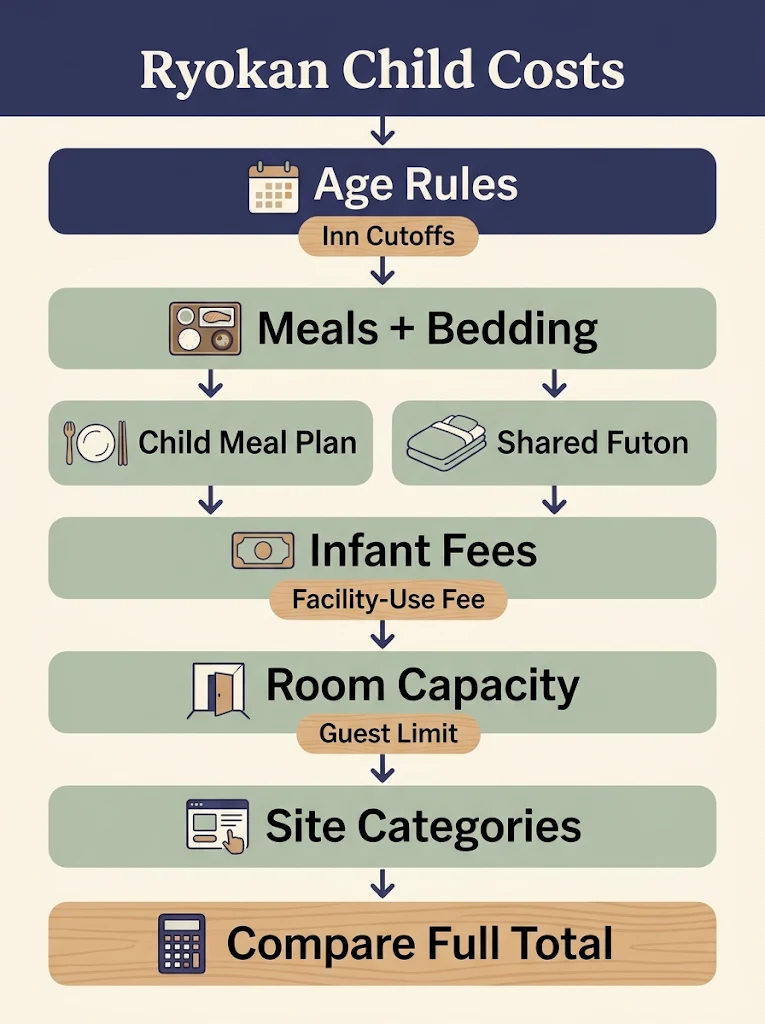
- Ryokan Child Rates by Age: Common Patterns, Not Rules
- How Meals and Bedding Affect Ryokan Child Rates
- When a Ryokan Charges an Infant Accommodation Fee
- How Room Capacity Affects Booking a Ryokan With Children
- How Booking Sites Display Ryokan Child Rates
- Compare Ryokan Child Rates Across Plans Before Paying
- Conclusion
- Sources and Further Reading
- Frequently Asked Questions
Ryokan Child Rates by Age: Common Patterns, Not Rules
How Age Categories Can Differ by Ryokan
Ryokan do not use one nationwide age cutoff for a child rate (子供料金). Each inn may group children by age, school stage, or the services selected, and the booking plan can add another distinction. A preschool child or young child (幼児) and an elementary school student (小学生) may therefore fall into different price categories at the same property. The label “child” alone does not tell you what the final charge includes.
Some properties use age bands, while others price children according to meals and bedding rather than age alone. In practice, age and plan set the actual rate, not a national formula. A booking site may show broad age categories, but the inn’s terms for a particular plan can differ, especially where age bands overlap with meal or bedding choices. Check the property’s own age-based rate rules for each child on its official site before booking.
Examples of Reduced and Adult Rates
The Japan Tourism Agency gives reduced rates such as 50% or 70% of the adult lodging rate as examples, not a standard scale. It says full adult rates are common for children aged 12 and over, but an individual ryokan may set a different cutoff. These figures are useful for a rough comparison only; they do not establish what a child will pay at another inn.
Aoyama Yamato in Ito shows how a specific schedule can work: its published rates are 50% for ages 4–5 and 70% for ages 6–12 when meals and bedding are included. For children aged 0–3, it lists fixed prices depending on meal choice, and says those prices apply whether or not bedding is used. These are the inn’s own terms, not a template for other ryokan.
| Source | Age or category | Published pattern |
|---|---|---|
| Japan Tourism Agency | Ages 3 and under | Many ryokan may waive lodging; meals or bedding may cost extra |
| Japan Tourism Agency | Reduced and adult rates | 50% or 70% are examples; adult rates are common at age 12+ |
| Aoyama Yamato, Ito | Ages 4–5 / 6–12 | 50% / 70% of adult rate with meals and bedding |
The Japan Tourism Agency examples are broad guidance, not a promise of a particular price. The young-child note refers to lodging charges only; meals or bedding can still add cost. Its reduced-rate examples also do not mean every inn uses the same percentages or age bands.
Aoyama Yamato’s schedule gives a concrete contrast: it assigns different percentages to two age groups when meals and bedding are included. Treat the property row as a property-specific example, not a current quote for another ryokan. The inn’s official site is the place to check for current terms before booking.
Why Children 3 and Under May Still Cost Extra
An infant with no separate bedding or meals can still add to the bill. The Japan Tourism Agency says many ryokan do not charge lodging fees for very young children, including those aged 3 and under, but may charge for meals or bedding. A no-service choice can reduce the price, yet it does not prove the stay is free; the property may define a separate flat child charge.
Nishimuraya Hotel Shogetsutei says, as a basic rule, it does not charge accommodation or facility-use fees (施設使用料) for kindergarten-age children and younger, but bills actual expenses when bedding, meal tickets, or other services are used. Aoyama Yamato instead lists fixed prices for ages 0–3 depending on meal choice. These policies show why age alone cannot settle an infant’s total.
How Meals and Bedding Affect Ryokan Child Rates
Compare Meals-and-Bedding Categories
Meal and bedding choices can change a child’s price even when the family shares one room. Booking categories separate meals and bedding into combinations rather than setting one universal child price. Select the child’s meal and bedding category before comparing plan prices. The category describes what the plan is intended to provide, but it does not show every possible fee.
A meals-and-bedding category usually includes both items, while meals only and bedding only include one. A neither category may exclude both, but it does not prove that the child stays free of charge. The inn may set another child price or a facility-use fee, so the booking category is only one part of the total.
| Category | What is provided | What to confirm |
|---|---|---|
| Meals and bedding | Meals and separate bedding | Menu, meal count, bedding type |
| Meals only | Meals; no separate bedding | Menu and meal count |
| Bedding only | Separate bedding; no meals | Bedding type and meal charges |
| Neither | No meals or separate bedding listed | Any child or facility-use fee |
The categories show which services are included in the child’s booking, not necessarily the full amount due. A neither option does not by itself mean a child stays free, and meals-only or bedding-only rates can still depend on the inn’s plan.
Child menus and bedding vary by property, so the same category may provide different things at different ryokan. The plan description needs to identify the meal arrangement and bedding; unclear details can affect both the price and what the child receives.
Check What a Child Meal Includes
A child’s meal category does not always mean the child receives the same dishes as an adult. Child menus vary by property; some inns provide a children’s menu, while others serve an adult-style meal. The listed rate may therefore cover a different meal from the one included in the adult plan, even when both guests are booked for meals.
The selected adult plan can affect what the child receives. Jalan says a child’s meal count follows the adult plan, so a child booked in a with-meals category does not receive dinner when the adult reservation is for breakfast only. Meal inclusion also varies by plan: some include dinner and breakfast, while others offer breakfast only or no meals. The child’s meal details matter.
Ask Whether Sharing a Parent’s Bedding Is Allowed
Sharing a parent’s bedding can affect the price, but it is not a single standard arrangement across ryokan. Some booking categories distinguish a child who uses separate bedding from one who does not. Whether a child may sleep alongside a parent, and whether that changes the charge, depends on the inn and the selected plan. The labels are not interchangeable.
A child without a separate futon may still need to be entered in the reservation, and the inn may apply a fee or occupancy limit. The booking description should make clear whether the child receives bedding, meals, or neither; a room shared with a parent does not automatically include those items. If the plan wording is unclear, the inn’s own child policy determines what the rate covers.
The video “Ryokan Questions” discusses how child rates can vary with age and with meal or bedding needs. It can help you understand why comparing those choices matters before selecting a family plan.
When a Ryokan Charges an Infant Accommodation Fee
No Meals or Bedding Does Not Always Mean Free
Parents may expect a baby or young child who shares a room and uses no separate bedding to stay free. That is not guaranteed. A ryokan may waive the lodging charge but still charge for meals, bedding, or use of its facilities. The key distinction is whether the inn waives only accommodation charges or other costs tied to the child’s stay as well.
The Japan Tourism Agency says many ryokan do not charge accommodation fees for very young children, such as those aged 3 and under, but may charge for meals or bedding. This is general guidance, not a nationwide rule. A no-meal, no-bedding child may still cost extra, so a displayed room price may not show the full family total.
What a Facility-Use Fee May Cover
A facility-use fee (施設使用料) is a separate charge a ryokan may apply for a child’s use of the property, rather than a standard lodging rate. The Japan Tourism Agency says some inns offer a family-priced option or a flat per-child amount under this label. The name alone does not show which services are included or whether meals and bedding cost extra.
Some properties instead charge actual costs when a child receives a service, such as bedding or a meal ticket. The amount and treatment depend on the inn and plan, and a charge may appear separately from the child rate. Ask the inn whether a child with no meals or bedding still incurs a fee. That distinction affects the full booking total.
Examples of Different Young-Child Policies
Policies differ even for children of similar ages. Aoyama Yamato in Ito lists 70% of the adult rate for ages 6–12 with meals and bedding, and 50% for ages 4–5 with meals and bedding. Its prices for ages 0–3 are fixed according to meal choice, and apply whether or not bedding is used. These are this inn’s terms, not a standard rate.
Nishimuraya Hotel Shogetsutei states that, as a basic rule, it does not charge accommodation or facility-use fees for kindergarten-age children and younger. It says actual expenses apply when bedding, meal tickets, or other services are used. The source pages do not provide a common industry rule, and property policies can change. The current terms of the selected inn determine the final charge.
How Room Capacity Affects Booking a Ryokan With Children
Children Using Bedding May Count Toward Capacity
A child’s rate and a room’s occupancy limit are separate calculations. Jalan’s booking guidance says children who need a bed or futon count toward room capacity, even when they pay a reduced rate. A lower child rate does not necessarily leave an extra place available for another guest. Bedding needs can affect room capacity, so the displayed price alone does not show whether the room fits your family.
For example, if a school-age child is booked with separate bedding, that child may count toward the room’s stated capacity. Rates do not decide capacity. A baby booked without bedding may be treated differently for the room’s bedding limit, but the property’s total occupancy restriction can still apply. The booking details need to reflect both who is staying and who needs a separate place to sleep.
No-Bedding Children May Still Face Occupancy Limits
Selecting no bedding does not automatically mean that a child can be added without limit. Jalan warns that a property may restrict the total number of guests under fire-safety capacity limits, even when some children do not need beds or futons. This means a family could meet the room’s bedding limit but still exceed its permitted occupancy.
The distinction matters for babies and toddlers sharing a parent’s bedding. A room’s capacity may account for all guests, not only those receiving a separate futon or bed. The booking page may show a price for a child without bedding, but that price does not by itself confirm the room can accept the full party. Room size, bedding arrangements, and total guest count are related but separate details.
| Child’s arrangement | Effect on bedding-based capacity | Other occupancy limit |
|---|---|---|
| Needs a bed or futon | Counts toward room capacity | Fire-safety limits may also apply |
| Does not need bedding | May not add to the bedding count | Total occupancy may still be restricted |
A child who needs a separate bed or futon can count toward the room’s capacity, even when the child has a reduced rate. Choosing no bedding may change the bedding-based count, but it does not establish that the room can accommodate another guest.
Jalan’s guidance also warns that fire-safety capacity may limit the total number of people, including children without bedding. Treat the two columns as separate checks: a room’s bedding arrangement and the property’s permitted total occupancy.
Confirm the Maximum Occupancy Before Reserving
The occupancy limit can vary by property and room, so a rate category is not enough to confirm that everyone can stay in the selected room. Confirm the permitted total occupancy with the property before booking. Include the number of adults and children in your party, and explain which children need separate bedding so the property can assess the room arrangement.
The Japan Tourism Agency and Jalan describe capacity policies as matters that depend on the accommodation and booking details; their guidance is not a single nationwide room rule. A booking system may reject a party that exceeds its listed limit, while a property may need to clarify how a child without bedding is counted. Keep the occupancy answer alongside the quoted total price, since a low child rate does not guarantee the room is suitable for your group.
How Booking Sites Display Ryokan Child Rates
Compare the Site’s Age Categories With the Inn’s Rules
A booking site’s age field may not match the ryokan’s own child-rate policy. Jalan’s general guidance treats children aged 12 or younger as eligible for child rates and guests aged 13 or older as adults, but it warns that individual properties and plans may set different age rules. The booking-site age label is only a starting point. Check which age category the specific plan uses before comparing prices.
Age cutoffs can also depend on what the child receives, such as meals or bedding. A child may fit the site’s child category but still have a different rate under the inn’s rules, or be counted as an adult for a particular plan. Jalan’s guidance has no stated publication date, so the current listing and the property’s own information are the useful references. That label is not a guarantee.
Match the Child’s Meals to the Selected Plan
A child’s meal arrangement may follow the adult plan selected for the room. Jalan says that, if the adults book a breakfast-only plan, a child entered in a with-meals category does not receive dinner through that plan. A child-rate label alone therefore does not show which meals are included. The plan’s meal details and the child’s selected category need to agree.
Child menus also vary by ryokan. Some properties provide a children’s meal, while others serve an adult-style menu; the bedding or futon included at a child rate varies too, according to Jalan. For a breakfast-only stay, the child’s meal selection does not add dinner automatically. The table compares the main booking checks, but the property’s current plan description determines what is included.
| Item | Jalan guidance | What to verify |
|---|---|---|
| Age category | Ages 12 and under may qualify for child rates; ages 13 and older are treated as adults | The property’s rule for the selected plan |
| Meals | A child’s meal count follows the adult plan | Whether the child’s category includes the meals you expect |
| Extra charges | A separate child facility-use fee may apply | Any fees not included in the displayed rate |
Jalan’s age categories are general booking guidance, not a rule shared by every ryokan. Its guidance also warns that individual properties and plans can use different age cutoffs, so the age label alone cannot confirm the applicable price.
Meal inclusion follows the selected plan, while separate child fees may sit outside the displayed rate. Use the table to compare the plan details and charges shown for the child; check the booking site and the property’s current information before paying.
Check for Charges Outside the Displayed Child Rate
A displayed child rate may not show every charge for the stay. Jalan warns that some accommodations add a separate facility-use fee for children, so a low or zero amount shown for the child category may not be the final total. The fee and its conditions vary by property. Review the booking site’s child categories and confirm any unclear charges with the property.
The final amount can depend on the child’s age category, meal and bedding choices, and any separate fee shown by the inn. Check that the booking summary includes the correct child and the intended meal arrangement, rather than assuming the adult room plan covers everything. The available details may differ between booking sites and the ryokan. Confirm the total shown before paying.
Compare Ryokan Child Rates Across Plans Before Paying
Compare Per-Person and Per-Room Pricing
Ryokan prices can be calculated per guest or per room, so the lowest displayed child rate does not automatically mean the lowest family bill. The Japan Tourism Agency describes both approaches: some inns charge each person, while others set a room price and add fees if the stated capacity is exceeded. The totals can differ. Compare the same room and plan, not just the child-price line.
With per-person pricing, the bill reflects each guest’s applicable rate and the selected plan. With per-room pricing, start with the room charge, then account for any extra fees that apply to your group or plan. A child’s meals and bedding can change the amount in either case, so the complete family total is the useful comparison. The table provides a template for recording those parts.
| Item | Per-person rates | Per-room pricing | Family plan or flat child fee |
|---|---|---|---|
| Base charge | Adult and child rates | Room charge | Plan price or child fee |
| Child meals | Record for each child | Add if charged separately | Check what is included |
| Bedding and facility-use fee | Record both if applicable | Add possible extra fees | Record any separate fee |
Use one column for each pricing approach under consideration. Record the room charge or individual rates, then add each child’s meals, bedding, and any facility-use fee.
The template highlights costs that can sit outside the displayed rate. A blank entry is not proof that an item is free; it means the plan details need clarification before the totals can be compared.
Check Whether a Family Plan or Flat Child Fee Applies
Some ryokan offer a family plan or a flat fee for each child instead of applying a percentage of the adult rate. The Japan Tourism Agency notes that a child charge may be described as a facility-use fee rather than a lodging fee. The label alone does not show what is included, so compare the stated price with the child’s meal and bedding choices.
A family-priced plan may work out differently from standard per-person rates, especially when children have different needs. The table separates the base charge from child-specific costs, including meals, bedding, and any facility-use fee. Treat blank or unclear items as costs to verify, rather than assuming they are included. Plan details and charges vary by inn and booking channel.
Confirm the Full Stay Cost With the Inn
For a fair comparison, use the same dates, room type, meal plan, and bedding arrangement for each option. Include every adult and child, then account for extra fees shown separately from the main price. Compare the complete family total for the same dates, room, meals, and bedding. This keeps a low advertised child rate from obscuring a higher combined bill.
Before paying, check that the quoted total reflects the children’s ages, meal categories, bedding requests, and any facility-use charge. The Japan Tourism Agency’s guidance describes general pricing patterns, not a guaranteed rate for every property. Policies and booking displays can change, and source information does not specify a verification date. The inn’s current official terms or a confirmed quote are the best basis for the final cost.
Conclusion
The best ryokan child rates are not always the lowest advertised ones; they are part of a plan that suits your family and has a confirmed total. A clear price makes it easier to choose with confidence.
Send the inn your children’s ages and the meal and bedding arrangements you want, then ask for the final amount before paying. A clear answer is worth keeping.
Sources and Further Reading
- Japan Tourism Agency — www.mlit.go.jp
- Jalan — www.jalan.net
- Aoyama Yamato — www.seizanyamato.jp
- Nishimuraya Hotel Shogetsutei — www.nishimuraya.ne.jp
- facility-use fee — www.mlit.go.jp
Frequently Asked Questions
- QWhat age counts as a child at a ryokan?
- A
There is no industry-wide age cutoff for child rates at ryokan. Jalan’s booking guidance treats children aged 12 and under as eligible for child rates and those aged 13 or older as adults.
Individual ryokan and plans can use different age categories. Check the property’s official information or ask the inn to confirm the applicable rule before booking.
- QDoes a child staying without meals or bedding stay for free?
- A
No, not always. The inn may charge a facility-use fee or another fee even if the child has no meals or separate bedding.
Some properties charge separately for meals, bedding, or other services. Check the inn’s policy and confirm the total before paying.
- QDo children sharing a room with a parent count toward room capacity?
- A
Sometimes. A child who needs a bed or futon may count toward the room’s stated capacity, even at a child rate.
Fire-safety occupancy limits can also apply when a child does not need separate bedding. Confirm the maximum occupancy with the ryokan before reserving.
- QWill my child receive dinner if I book a breakfast-only ryokan plan?
- A
Not necessarily. Jalan says a child’s meal count follows the adult plan, so a breakfast-only plan does not include dinner for a child booked in a with-meals category.
Check the selected plan’s meal details on the booking site or with the ryokan before paying, since meal options can vary by facility and plan.